Car wash automation works by moving a vehicle through a controlled sequence of mechanical, chemical, and digital processes, from the moment it enters the wash bay to the moment it exits clean and dry. Sensors detect the vehicle, automated equipment applies water, soap, and rinse agents and operates brushes at precisely timed intervals, and software coordinates every step in real time. The sections below break down each stage of that process in detail.
What happens when a car enters an automated car wash?
When a car enters an automated car wash, it triggers a series of coordinated events managed by the car wash system. The vehicle is detected at the entry point, its wash package is confirmed, and the conveyor or rollover mechanism activates to guide it through the wash tunnel at a controlled speed. From this moment, the system takes full control of the sequence.
At the entry gate, the driver is typically prompted to select or confirm a wash package via a touchscreen terminal or a pre-purchased membership. Once payment or membership validation is confirmed, the gate opens and the driver is instructed to pull forward onto the conveyor track or into the wash bay. Indicator lights and audio cues guide the driver to position the vehicle correctly and shift into neutral.
The system then logs the vehicle into the active wash queue, assigns the correct chemical profile and equipment settings for the selected package, and signals the first stage of the wash to begin. Every subsequent action in the tunnel is triggered by this initial entry event, making the entry gate one of the most critical control points in the entire automated car wash operation.
How do car wash sensors and cameras identify each vehicle?
Car wash sensors and cameras identify each vehicle by detecting its physical dimensions, position, and movement as it enters and travels through the wash tunnel. Loop detectors embedded in the floor, infrared sensors, laser scanners, and optical cameras work together to build a real-time profile of the vehicle’s size, shape, and speed, allowing the car wash equipment to adjust accordingly.
Loop detectors are wire coils buried beneath the conveyor surface that sense changes in the electromagnetic field when a vehicle passes over them. These signals confirm presence and trigger stage transitions throughout the tunnel. Infrared and laser sensors map the vehicle’s height and width, which is especially important for adjusting brush pressure, arch positioning, and dryer angles to suit everything from compact cars to large SUVs.
In more advanced car wash automation systems, cameras and computer vision add another layer of identification. License plate recognition cameras can link a vehicle to a specific customer account, a prepaid wash package, or an active car wash membership, eliminating the need for the driver to interact with a terminal at all. This combination of physical sensors and optical recognition is what allows modern car wash systems to handle high vehicle throughput accurately and efficiently.
How does automated payment processing work at a car wash?
Automated payment processing at a car wash works through a point-of-sale terminal at the entry kiosk, where customers pay by card, contactless payment, or mobile app before the wash begins. The car wash POS system validates the transaction, assigns the correct wash package, and signals the gate to open, all within seconds and without requiring any staff involvement.
Modern car wash POS systems support multiple payment methods, including chip and contactless cards, mobile wallets, QR codes, and in-app purchases. For customers enrolled in a car wash membership or loyalty program, the system can identify them automatically through license plate recognition or a membership barcode, bypassing manual payment entirely and simply logging the visit against their account.
On the back end, each transaction is recorded in the car wash management software, giving operators a complete view of revenue, package popularity, and customer visit frequency. This data is valuable not just for accounting but for understanding which wash tiers perform best and how membership holders behave compared to pay-per-wash customers. Integrated payment processing removes friction for the customer while giving operators the business intelligence they need to make informed decisions.
What equipment is used in each stage of the wash cycle?
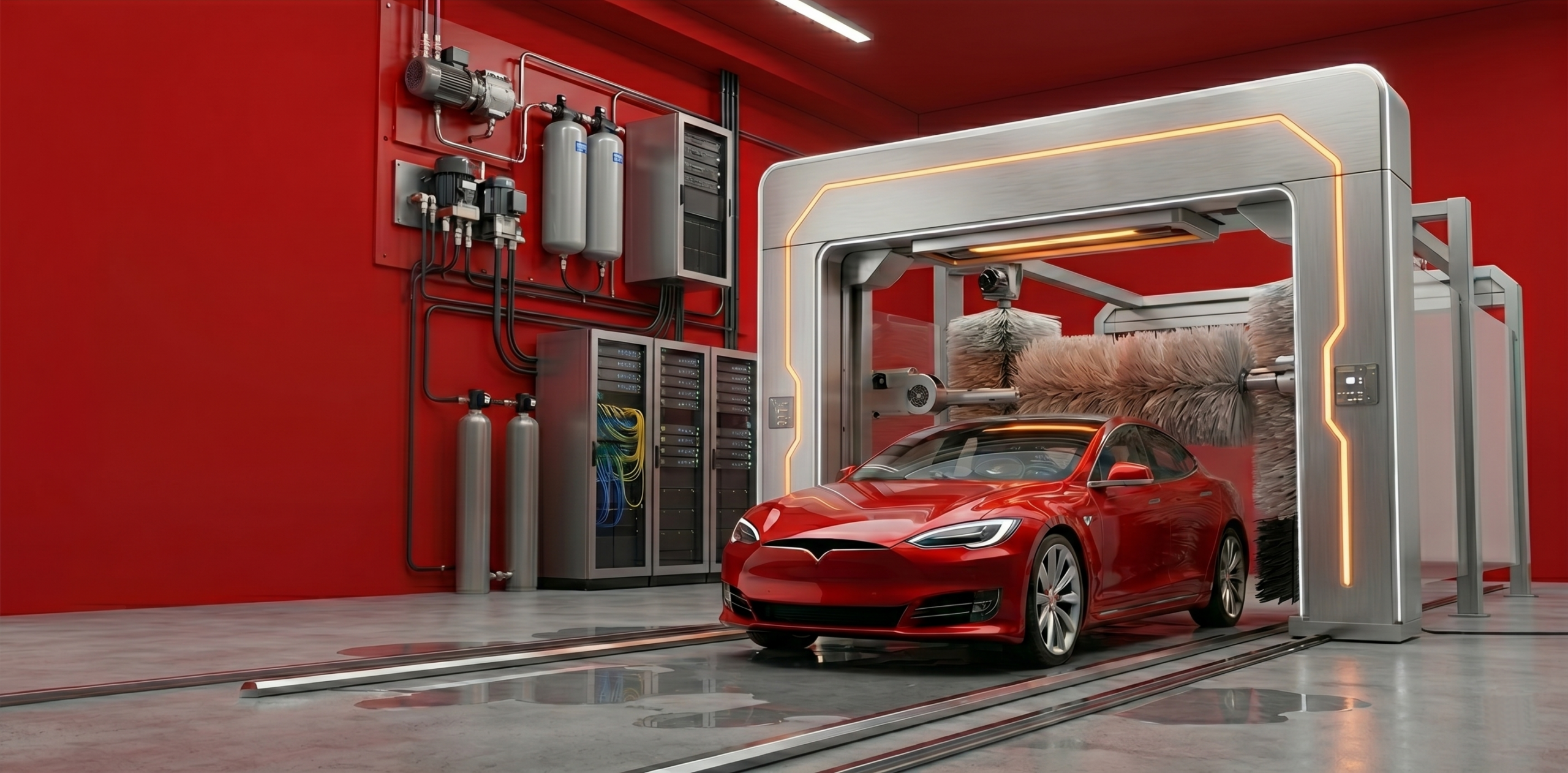
Each stage of the wash cycle uses dedicated car wash equipment designed for a specific cleaning function. The typical tunnel sequence includes a pre-soak arch, high-pressure water jets, rotating brushes or soft-cloth mitters, foam applicators, a rinse arch, a spot-free rinse system, and a high-velocity dryer. Each piece of equipment activates and deactivates based on sensor input and the wash package selected.
Pre-wash and wash stages
The cycle begins with a pre-soak application that loosens dirt, road grime, and brake dust before any mechanical contact occurs. High-pressure water jets then blast away loose debris from the wheels, undercarriage, and body panels. Rotating brushes or soft-cloth mitters follow, providing the mechanical agitation needed to remove bonded contamination. Foam applicators introduce detergent at this stage, with chemical concentration adjusted based on the selected package tier.
Rinse and dry stages
After the wash stage, a fresh water rinse arch removes all chemical residue from the vehicle’s surface. Higher-tier packages typically include a spot-free rinse using deionized or reverse-osmosis-treated water, which prevents water spots from forming as the vehicle dries. The final stage is the dryer, where high-velocity air blowers push water off the vehicle’s panels and glass. Some systems include side blowers and an underbody dryer as part of premium wash packages.
How does a car wash know when to stop and release a vehicle?
A car wash knows when to stop and release a vehicle through exit sensors positioned at the end of the tunnel. When the vehicle’s rear clears the final sensor zone, the system confirms the wash cycle is complete, deactivates the remaining equipment, and signals the exit gate to open. The entire release sequence is automated and requires no manual input.
Throughout the tunnel, the car wash system tracks vehicle position continuously using the sensor array. Each sensor zone corresponds to a stage transition, so as the vehicle moves forward, equipment ahead activates and equipment behind deactivates in sequence. This prevents any stage from running unnecessarily and ensures the vehicle is never released before all wash stages have been completed.
In the event of a fault, such as a vehicle stopping unexpectedly or a sensor detecting an obstruction, the system halts the conveyor and alerts the operator. Safety interlocks prevent the exit gate from opening until the fault is cleared, protecting both the vehicle and the equipment. This level of automated oversight is what allows car wash chains to operate tunnels at high volume with minimal staff on the floor.
How does car wash management software connect to the physical equipment?
Car wash management software connects to physical equipment through a network of programmable logic controllers (PLCs) and IoT-enabled devices that translate software commands into real-time equipment actions. When a customer selects a wash package, the software sends the corresponding configuration to the PLC, which then controls which equipment activates, for how long, and at what intensity throughout the wash cycle.
This connection works in both directions. The software sends instructions down to the equipment, and the equipment sends status data back up to the software. Operators can monitor tunnel throughput, equipment cycle counts, chemical consumption, and fault alerts from a centralized dashboard, often accessible remotely via a cloud-based platform. This real-time visibility is what separates a modern car wash automation system from older, manually configured setups.
We build our car wash management software platform around exactly this kind of deep integration, connecting the digital customer experience, including membership management, car wash loyalty programs, and mobile app interactions, directly to the operational layer that runs the physical equipment. When a customer redeems a loyalty reward or upgrades a wash package on their phone, that instruction flows through to the tunnel in real time. The result is a unified car wash system where the digital and physical sides of the business operate as a single, coordinated whole rather than two separate systems running in parallel.